

License Plate Redaction Demand Surges 260% as ALPR Privacy Lawsuits Threaten Billions in Penalties
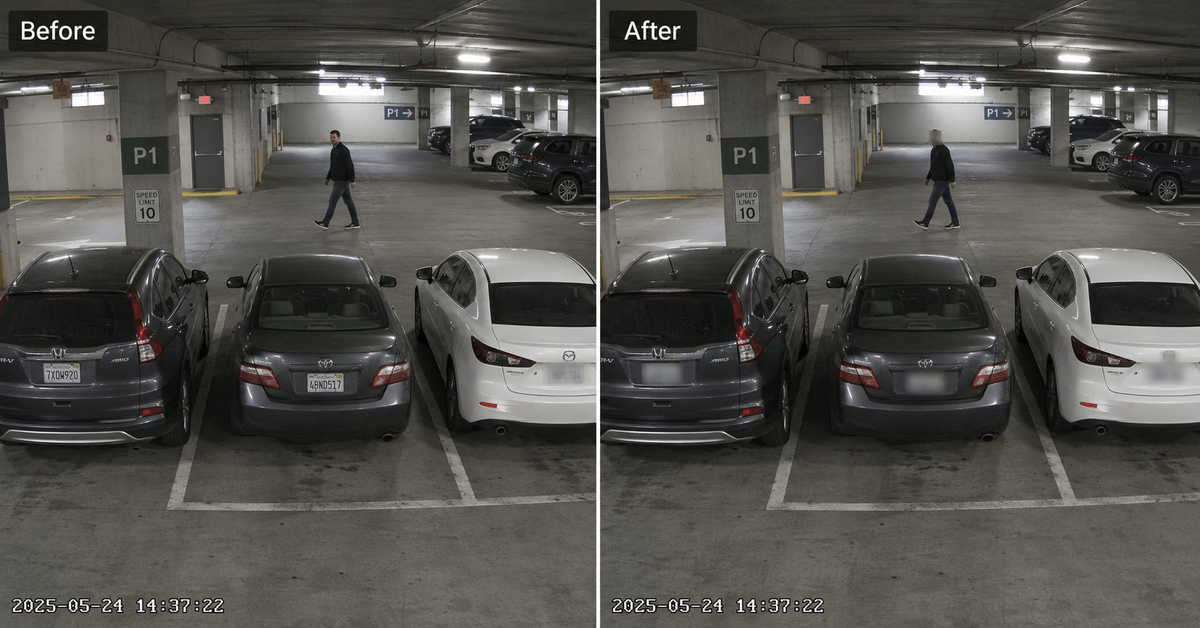
Simulated surveillance footage for illustration purposes. Not actual customer data.
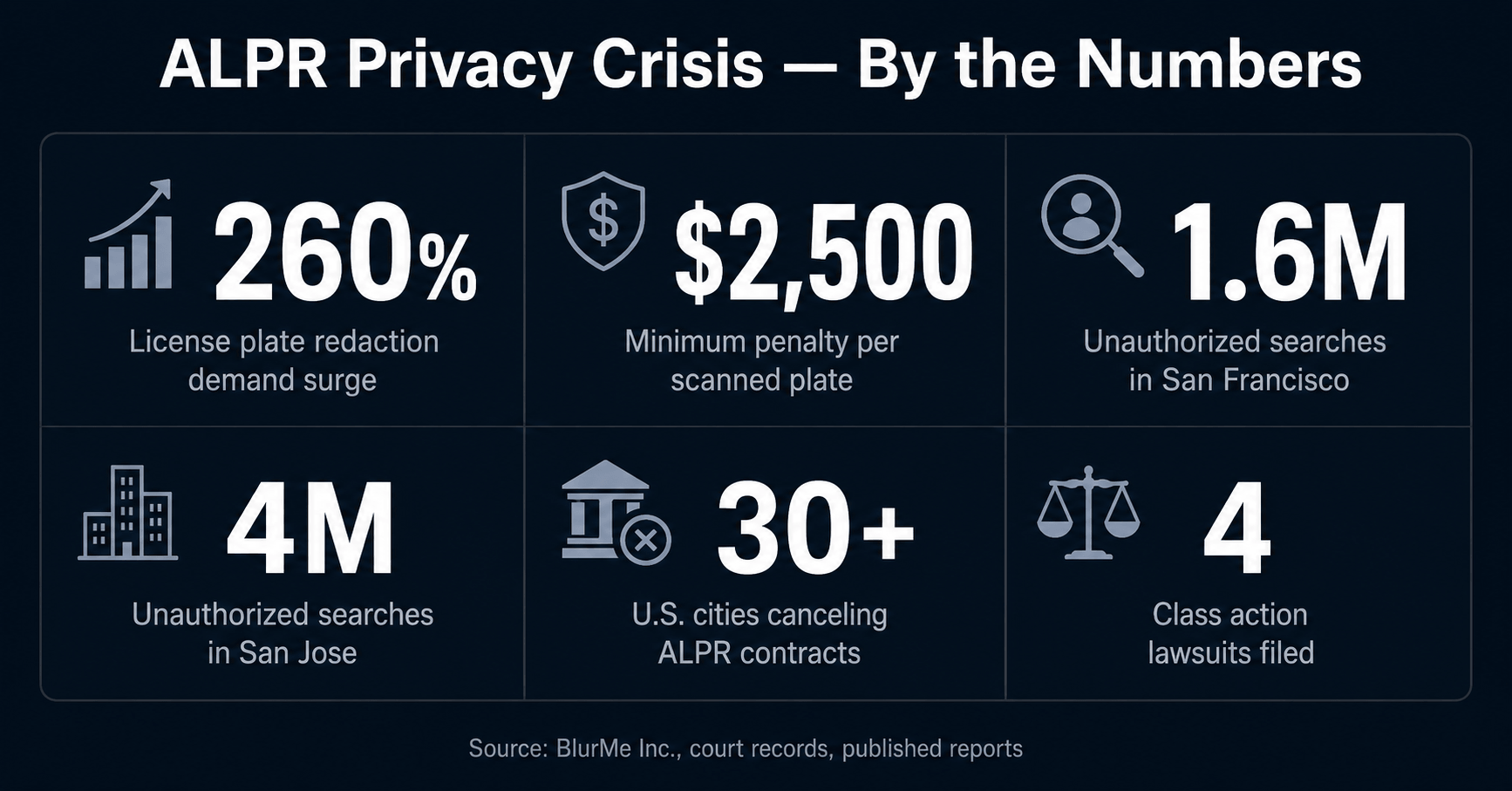
ALPR Privacy Crisis — By the Numbers
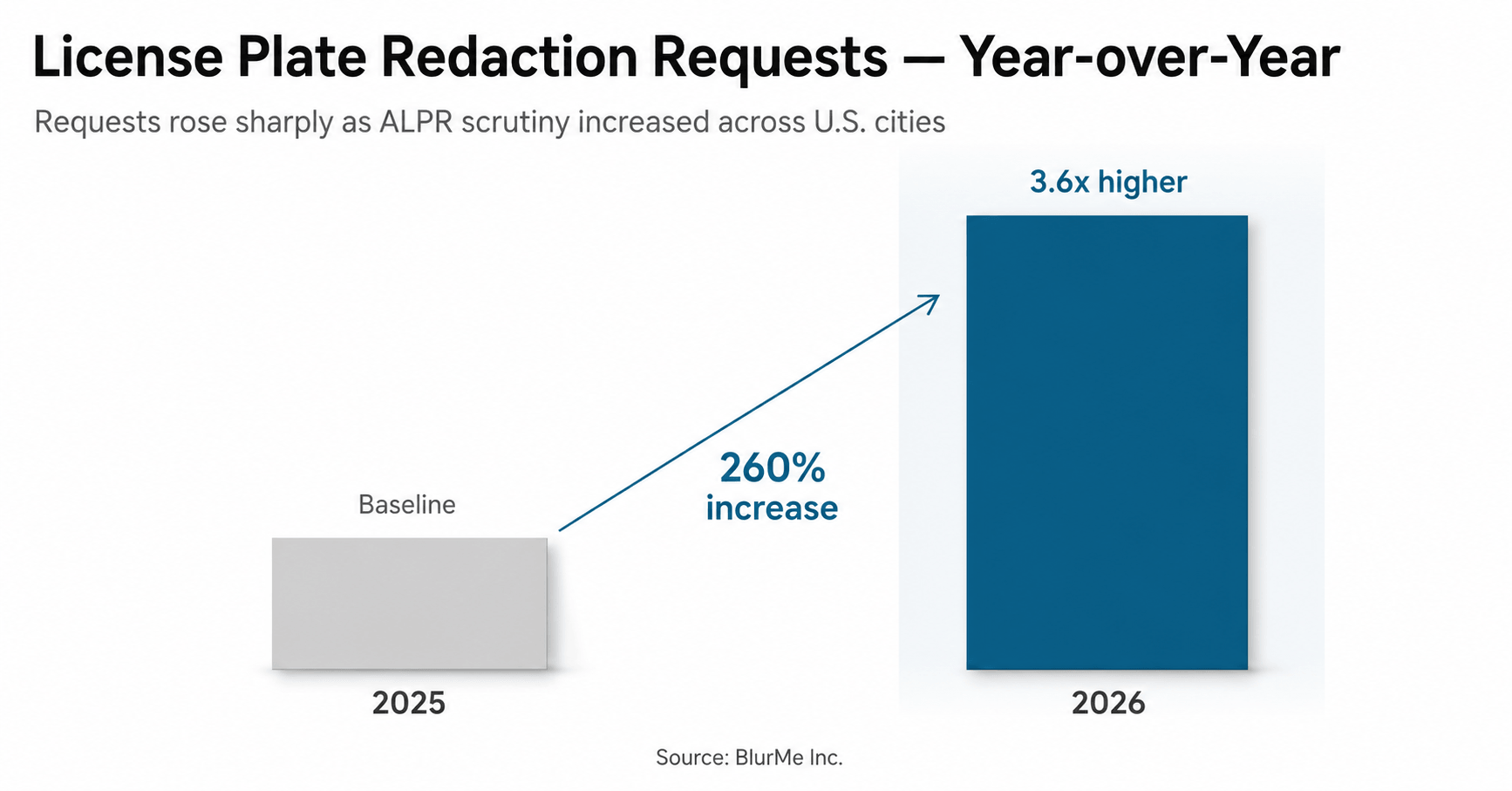
License Plate Redaction Requests — Year-over-Year
BlurMe reports 260% surge in license plate redaction demand as Flock Safety ALPR lawsuits expose businesses to $2,500-per-violation penalties in California.
In February 2026, a California appeals court ruled in Bartholomew v. Parking Concepts that any entity operating an ALPR camera without a compliant privacy policy owes at least $2,500 per scanned plate — even without proof of data misuse. Within six weeks, four class action lawsuits were filed targeting businesses deploying Flock Safety cameras, including Simon Property Group's 23 California shopping malls. At least eight more investigations are underway.
The crisis deepened when investigations revealed that San Francisco's Flock Safety camera database had been searched over 1.6 million times by out-of-state and federal agencies — including ICE — over seven months, violating California law. In San Jose, nearly four million searches were logged over a single year. Similar unauthorized access surfaced in Mountain View, Ventura County, and Oxnard, all traced to vendor-side configuration errors that reactivated data-sharing features local authorities had explicitly disabled. Multiple cities have since terminated their Flock Safety contracts, and the California Attorney General filed an enforcement action against El Cajon for systematic data-sharing violations.
ALPR cameras capture far more than license plates. Every frame can contain faces, passengers, pedestrians, and vehicle characteristics — all classified as personally identifiable information under privacy law. Meanwhile, California, Washington, Virginia, and Colorado are each enforcing different retention limits, sharing restrictions, and disclosure requirements. At least 30 U.S. cities have canceled or suspended ALPR camera contracts since January 2025, with Berkeley city attorneys warning in May 2026 that their city faces lawsuit risk due to Flock Safety's "simple negligence."
This multi-layered compliance challenge has exposed the limits of legacy redaction methods. Many organizations still rely on manual, frame-by-frame video editing — a process so slow that a single hour of footage can take days to redact, and so error-prone that missed faces or plates in a single frame create legal exposure. Others outsource redaction on a case-by-case basis, only acting when a public records request or lawsuit forces their hand. Neither approach can keep pace with the volume of footage modern ALPR systems generate daily, and both leave organizations exposed during the gap between capture and redaction.
"Most businesses operating ALPR cameras have no redaction process at all," said Julian Seo, CEO of BlurMe Inc. "Those that do are still editing frame by frame or waiting until a lawsuit arrives to act. When a single camera records thousands of plates and faces per day across multiple states with different laws, the only realistic option is AI that processes footage automatically, consistently, and at the speed the data is being generated."
BlurMe's platform automatically detects and masks license plates, faces, and vehicle identifiers in video and image files — processing in minutes what legacy redaction tools take days to complete. By redacting personally identifiable information before footage is stored or shared, organizations stay protected even when access controls fail or vendor errors expose data to unauthorized parties. Already used by more than 600 U.S. school districts and enterprise customers worldwide, BlurMe is available as a cloud SaaS platform at blur.me and as an on-premise enterprise solution.
Referenced Cases:
Bartholomew v. Parking Concepts, Inc., Case No. A171546, Cal. Ct. App. 1st Dist., Div. 5, Feb. 5, 2026.
Leonard v. Simon Media Properties, LLC, filed Feb. 17, 2026, San Diego Superior Court. Counsel: Bursor & Fisher, P.A., (914) 874-0708.
Javorsky v. Flock Group, Inc., filed Feb. 26, 2026, San Francisco Superior Court. Counsel: Gibbs Mura / Milberg PLLC, 866-407-2032.
Danielle King
BlurMe Inc.
+82 70-8666-6056
content@blur.me
Visit us on social media:
LinkedIn
X
YouTube
Facebook
Instagram
Legal Disclaimer:
EIN Presswire provides this news content "as is" without warranty of any kind. We do not accept any responsibility or liability for the accuracy, content, images, videos, licenses, completeness, legality, or reliability of the information contained in this article. If you have any complaints or copyright issues related to this article, kindly contact the author above.
